
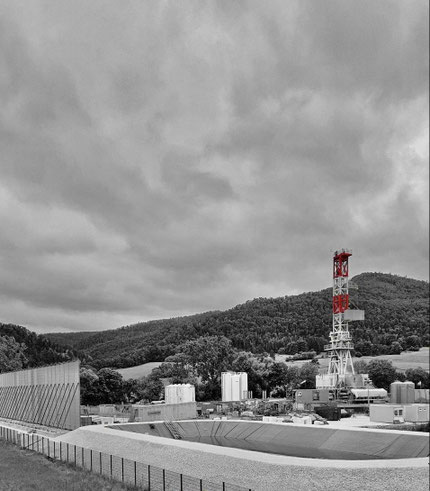
A Landmark Project for the Future of Geothermal Energy in Switzerland
The pilot geothermal power plant project in Glovelier, in the municipality of Haute-Sorne (Jura), began drilling on 21 May 2024, following a decade of political and legal deadlocks and local opposition. The Swiss start-up Geo-Energie Suisse aims to generate CO2-free electricity from heat extracted from deep within the earth.
For the Swiss start-up Geo-Energie Suisse AG, this project is a real make-or-break venture: failure would likely spell the end of deep geothermal research in Switzerland.
American inspiration: the Google model
The sector’s palpable optimism is based on close collaboration with the American company Fervo Energy. In Nevada, the latter commissioned a geothermal power station at the end of 2023 to supply Google’s data centres. This sets a positive precedent for the Swiss project.
- Technology transfer: The process used in the United States is based on a method patented by Geo-Energie Suisse AG for Switzerland.
- Safety demonstration: In Nevada, the rock was successfully stimulated without causing any perceptible earthquakes, with measured activity not exceeding 1.8 on the Richter scale. This should help to avoid the trauma of the 2006 Basel project failure, which had triggered earthquakes.
Fervo already has ambitions to build a large-scale power plant (400 MW) in Utah by 2028.
The process: extracting heat from granite
The technology used in Haute-Sorne is complex:
- Depth: a vertical borehole drilled to a depth of 4,000 or 4,500 metres to reach the crystalline basement (granite/gneiss) at a temperature of 150 to 200 °C)
- Horizontal deviation: as is done in the United States, the boreholes are deviated horizontally at depth to increase the surface area in contact with the heat (approximately 190 to 200°C);
- The heat exchanger: cold water is injected deep underground via a system of artificially created fractures, heats up on contact with the hot rock and returns to the surface via a second borehole to generate electricity;
A phased approach to prevent earthquakes
In order to minimise seismic risk, Geo-Energie Suisse is adopting a more cautious strategy than its American counterparts. The pressures and volumes of water used are significantly lower, namely 500,000 to 1 million litres of water instead of 60 million litres.
Furthermore, the Swiss Seismological Service monitors the project in real time using state-of-the-art fibre-optic measurement technology. This allows for the controlled opening of small fractures to connect two parallel wells (a cold water injection well and a hot water recovery well) without triggering tremors felt by the population.
To minimise the risk of earthquakes, Geo-Energie Suisse is adopting a more cautious strategy than its US counterparts. The project operates with significantly lower water pressure and volume. Furthermore, the Swiss Seismological Service is monitoring the project in real time using state-of-the-art fibre-optic measurement technology.
Financial considerations
The total cost of the Haute-Sorne project is estimated at 130 million Swiss francs. Geo-Energie Suisse is supported by several investors (including Energie Wasser Bern and Elektra Baselland), a contribution from the City of Zurich (9 million) and an exploration grant from the Swiss Confederation amounting to 90 million.
Ultimately, the Jura power station is expected to have a capacity of 5 MW and supply electricity to around 6,000 households. The federal authorities’ objective is to achieve 2 terawatt-hours of electricity generation from deep geothermal energy by 2050. To make such infrastructure profitable in the future, operators stress that it will be essential to combine electricity generation with heat production for industry, which will then allow new plants to be built closer to urban areas.
Geothermal energy remains a financial challenge. Whilst drilling costs in the US are falling sharply due to government subsidies and economies of scale, Switzerland is focusing on combined use:
- Electricity & Heat: To be profitable, heat for industry is to be supplied alongside electricity in future.
- Funding: The CHF 130 million project is being funded by prominent investors (including Energie Wasser Bern and the City of Zurich) and the federal government (a CHF 90 million exploration grant).
Outlooks
Haute-Sorne is regarded as the “last chance” for deep geothermal energy in Switzerland. If the project is successful, this could mark the start of further plants near urban areas. By 2050, the federal government expects deep geothermal energy to be able to supply around 2 terawatt-hours of electricity – equivalent to roughly two-thirds of the output of the former Mühleberg nuclear power station.
Background: This article is based on current developments surrounding the geothermal project in Haute-Sorne and comparisons with US pilot projects.
Link to the article in the Tages-Anzeiger (in German, for subscribers only)