
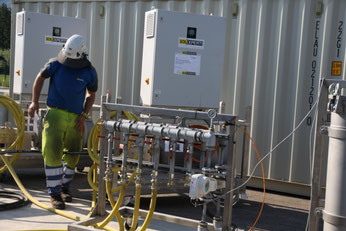
The stimulation tests, which lasted around a month, have been successfully completed.
The work proceeded according to plan and the expected objectives were achieved. All the required data were recorded. No seismic events were felt, but microseismicity was observed, as anticipated.
The aim of the stimulation tests was to quantify the potential for increasing the rock’s permeability and thereby assess the feasibility of circulating water through it in the future geothermal reservoir. These tests also represent one of the most important factors in reducing seismic risk. The data collected will enable the mechanical and hydraulic properties of the rock to be characterised, thereby defining the operational parameters for the actual stimulation (pressures, flow rates, durations) and the optimal orientation of the future horizontal well. Stimulation of the geothermal reservoir is planned for the second phase (2026–2027), should the project proceed beyond the exploration phase.
The tests were divided into a series of stages, the chronology of which is as follows:
- Preparatory work began on 24 June, including a temperature measurement at a depth of 3,986 metres. The result, 135°C, was in line with expectations. A temperature of over 150°C is expected in the future geothermal reservoir at a depth of 4,500 to 5,000 metres.
- The borehole casing was then perforated at a depth of 3,800 metres.
- A chain carrying eight seismometers was lowered to the bottom of the borehole using a winch and a crane. They were calibrated using a vibrating truck.
- On 8 July, water injection began. This was carried out using pumps normally fitted to the Val Bedretto underground laboratory, which were loaned by ETH Zurich. Over several days, the flow rate and pressure were gradually increased, reaching a maximum of 80 l/min and 270 bar.
- Water injection was halted on 14 July after a threshold magnitude was reached on two occasions, in accordance with the established guidelines. The well was opened to relieve the pressure. The total volume injected amounted to 430 m³. The plan had provided for an optional second stimulation cycle (500 m³), but this was not necessary as the data collected was sufficient.
- The final days, up to 31 July, were devoted to supplementary hydraulic and geophysical measurements, as well as monitoring and observing seismicity, backflow and all other monitored parameters.
The work required the collaboration of several companies equipped with specialist high-tech equipment. Specialists were on site 24 hours a day to ensure the safety of operations, as the injection took place continuously. Despite these working hours, no noise nuisance was caused. Environmental monitoring, in particular the analysis of the backflow water (13 m³), was carried out by a specialist engineering firm.
With regard to seismicity, 3,387 seismic events had been detected by 31 July using the well seismometers, all of very low magnitude.
Only four tremors were detected during the injections by the surface network and localised by the Swiss Seismological Service (SED) at ETH Zurich, as part of its independent baseline seismic monitoring. The strongest tremor was measured at a magnitude of 0.3 on this network. As expected, seismic activity declined sharply as soon as the injections ceased. It now stands at just 2 or 3 microseismic events per day, compared with several hundred during the tests.
The well is currently secured. Continuous monitoring of pressure and seismicity remains in place. Over the coming months, operational activities will be limited to maintenance work and any additional measurements that may be required.
The next step will involve analysing the data collected during the exploration phase, which will enable, in particular, the geological model and risk assessments to be updated. Geo-Energie Suisse will assess whether or not to proceed with the project as planned and will submit its reports to the relevant authorities, who will examine them with the support of the GEI (group of independent experts). The project can only go ahead if all safety requirements are met.
As a reminder, should the results be favourable, this project could supply electricity to more than 6,000 households.
Contact: Olivier Zingg — CEO, Geo-Energie Jura SA — Phone +41 79 321 43 20
| Geo-Energie Suisse AG is Switzerland’s centre of excellence for deep geothermal energy for power and heat generation. The company was founded in November 2010. Its founding members include municipal utilities and regional energy suppliers from across Switzerland (aet, EBL, ewz, EOS, ewb, GVM, iwb). Geo-Energie Suisse AG employs around 20 people and is supported on a project basis by external specialists. |
| Geo-Energie Jura SA was founded in 2015. Its shareholders are Geo-Energie Suisse AG, ebl, ewb and ewz. The company’s purpose is to implement and subsequently operate the Haute-Sorne geothermal project. Under a tripartite agreement concluded in June 2015 between the Municipality of Haute-Sorne, the Canton of Jura and Geo-Energie Suisse AG, the company is based in the Municipality of Haute-Sorne. |
